
You've probably heard of Alpha Centauri. It's often called the nearest star to us, though strictly it is the nearest star system to us. That's because Alpha Centauri is actually three stars - Alpha Centauri A, Alpha Centauri B, and Proxima Centauri. Proxima it is - the name may have given it away - that's the nearest star to us.
So with that clear ... Proxima Centauri is about 4.2 light-years from us. That's about 39 trillion km. If you're anything like me, you will have a hard time grasping just how large a number, a distance, that is, even if it is the nearest star. So I like to put it in perspective this way: our Sun is about eight light-minutes from us. That is, light takes eight minutes to travel from the Sun to us. But light takes over four years to travel from Proxima to us.
Think of spending eight minutes walking. How far will you get? Perhaps half a km from home. Fine, so where will you reach if you walked for four years? Well, that's the comparison to make between the distances to the Sun and Proxima.
It always takes me a few seconds - if not eight minutes, not four years - to fully comprehend that. But let's put that distance to Proxima in perspective another way.
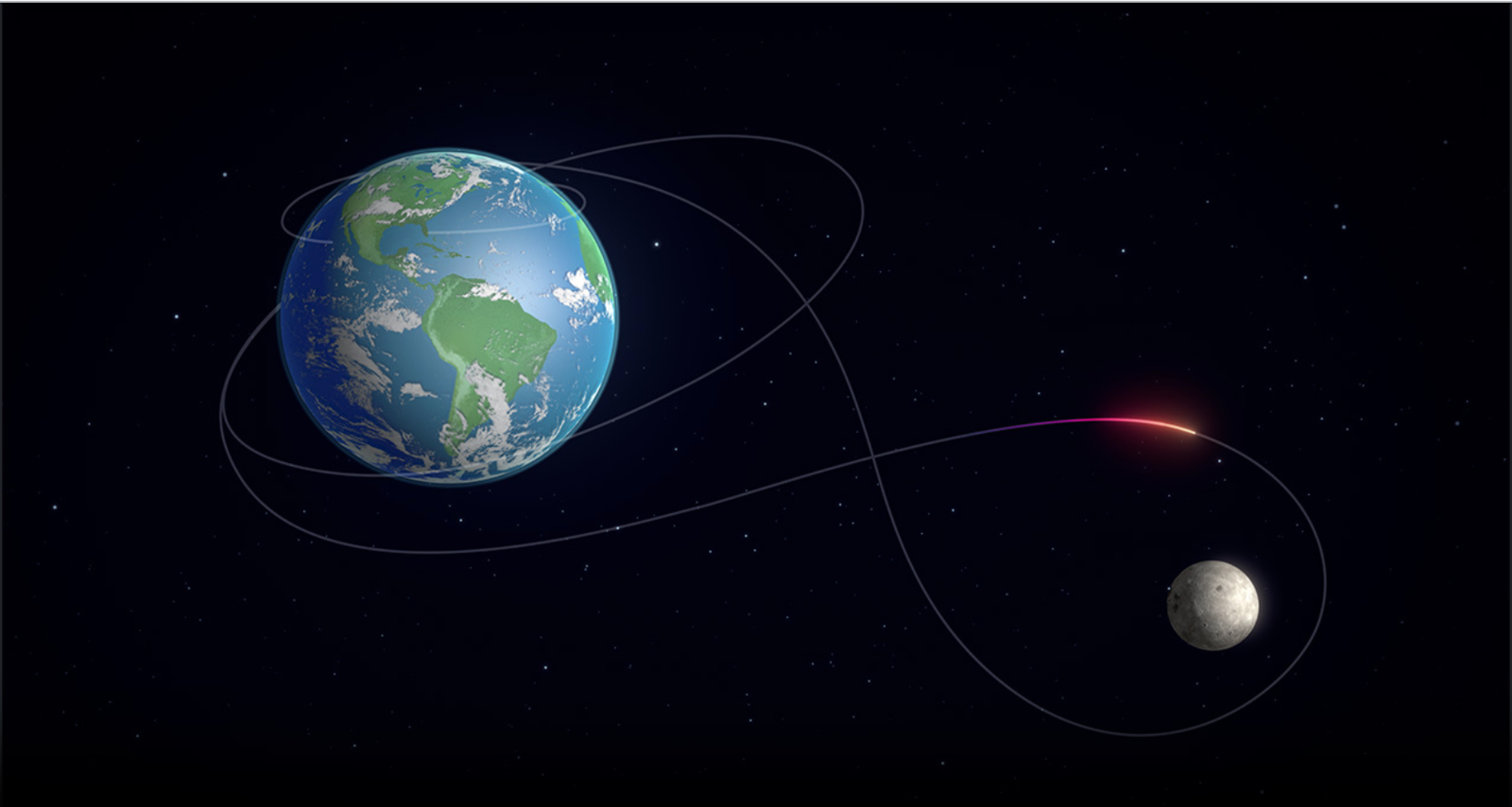
The recent Artemis mission to the Moon raced along at speeds close to 40,000 kmph. Question: Travelling that fast, how long would Artemis take to traverse the 39 trillion km to Proxima?
Answer: about 114,000 years.
And Proxima is the closest star to us! There's little hope of us humans ever getting there, let alone stars even more distant. Sirius, the brightest star in the night sky, is twice as far from us as Proxima; Betelgeuse, the enigmatic red giant in Orion, is 60 times as far as Sirius. No hope.
Yet Proxima's very proximity has always got astronomers and space scientists to wonder what might take us there. Fair enough, propulsion technologies we know about, like what took Artemis to the Moon, are no good if we want to reach Proxima Centauri. But that only begs the question: is there another way? Or put it like this: the fastest that humans have been able to travel is miserly compared to the speed of light. Is there some way we can get a spacecraft to approach that incredible speed? Think of it - if we can ramp up to a tenth of the speed of light, we will reach Proxima in a little over 40 years. Still a long time, but at least comprehensible, and nowhere close to as inconceivable as 114,000 years.
This is really what any effort to reach Proxima amounts to - a search for ways to accelerate to somewhere near the speed of light. And that's just what some researchers at Texas A&M University think they have hit upon. ("Optical propulsion and levitation of metajets", Kaushik Kudtarkar et al, Newton, June 1 2026). In effect, they show that we can use light itself to propel objects.
The general idea is not new. In 2024, NASA launched the Advanced Composite Solar Sail System (ACS3), a spacecraft that, once in space, unfurled a gigantic sail. What wind was this ACS3 sail hoping to catch? Nothing we know on Earth, of course. The Sun emits tiny particles of light known as photons. When these hit the sail, they actually push ACS3 forward, much like happens with sailboats on Earth.
The Texas A&M scientists have a different vision. They designed tiny "vehicles" called "metajets". These are made of extremely thin materials called "metasurfaces", shaped in intricate patterns. These metasurfaces are designed so that the metajets are "capable of manipulating light to be driven or propelled in desired directions."
Think of what they are saying in those few words, which is something truly remarkable. "When illuminated by a normally incident beam," they write, "these free-standing devices simultaneously translate laterally and lift vertically, enabling 3D motion. ... [They respond to] unbalanced forces from light refraction at a specific angle."
In other words, light can actually move these microscopic objects, and by controlling how light falls on them, we can actually control that motion.
So what, I can almost hear you asking. So these guys have shown that light can move objects that are extremely tiny. How is that going to help anyone reach Proxima Centauri?
Well, the theoretical framework that makes this microscopic motion possible, the paper tells us, also "scale with optical power and are not fundamentally constrained by device size." Once again, a few words positively dripping significance. What the authors suggest is that with enough "optical power" - think of that as a bright enough light - we can move objects equipped with "interstellar light sails for space travel." (Like ACS3.)
And pushing such an object in this way long enough will, of course, steadily accelerate it, and to speeds much greater than our modern spacecraft like Artemis can manage. To speeds, in fact, that approach the speed of light. According to a Texas A&M press release, "this breakthrough may one day enable travel to Alpha Centauri within roughly 20 years."
114,000 years, shrunk to 20.
There's much to read and understand in the Texas A&M paper, plenty of it certainly way beyond me. Yet even the small fraction of the paper that I follow leaves me breathless, awestruck, but definitely impatient.
For I think an endeavour to travel to our nearest stellar neighbour might be the grandest experiment humanity has ever dreamed of. I don't say this lightly: I sincerely hope I'm alive to see even a glimmer of it taking shape.

















Write a comment ...